

|
|
|
| HomeAbout Billiards DigestContact UsArchiveAll About PoolEquipmentOur AdvertisersLinks |
|
Browse Features
Tips & InstructionAsk Jeanette Lee Blogs/Columns Stroke of Genius 30 Over 30 Untold Stories Pool on TV Event Calendar Power Index |
Current Issue
An 'A’ in Chemistry Team Europe took no chances, prepping and bonding for two weeks before stomping Team USA in the Mosconi Cup By Keith Paradise Photos by Taka Wu A month before this year's Sportsbet.io Mosconi Cup was set to begin, European team captain Jayson Shaw had an idea. Why not bring the five-man squad together for two straight weeks before the four-day competition that pits teams from Europe and United States starts and have a training session in Scotland, Shaw's home country. The request would require a bit of selflessness on the part of the team, with the players needing to skip the International 9-Ball Open in Florida, a tournament that Shaw has won in the past and which carries Matchroom and World Pool Association ranking points. It wasn't a rare ask for Shaw, who gathered his team for a week last year for some bonding, camaraderie, team building and training before the Mosconi Cup in Orlando — a Cup that resulted in a decisive European win. He had good reasoning for wanting to get this group together sooner, since this year's European team had a bit of a different look than previous years. Sure, you had the always steady and confident swagger of Shaw, operating as a playing captain for the second straight year along with the veteran presence of David Alcaide of Spain. He also had Joshua Filler returning to the team after being left off the squad last year due to his decision to compete in the World Pool Association's World 8-Ball Championships while many fellow professionals boycotted the event. Like Shaw, the German thrives under the bright lights and big crowds that come when competing on pool's biggest stage, using the jeers from opposing fans as fuel for a game that has already produced a United States Open Pool Championship, a World Pool Championship and two China Open titles in his still young career. Filler said that he was so dejected over being left off last year's team that he didn't even watch the event. But rounding out the team would be not one, but two rookies — Germany's Moritz Neuhausen and Lithuania's Pijus Labutis. The German, who had spent the previous two years crisscrossing the globe for Matchroom ranking points to try and qualify for this event only to come up short, decided to not focus on ranking points this year at all and wound up having the best year of his career, winning the Peri 9-Ball Open and Premier League Pool while finishing second at the Hanoi Open that was won by Libutis, one of three victories for the Lithuanian this year. The time spent together would give the European team the opportunity to work on their games in preparation for pool's biggest stage while allowing Shaw to see which doubles pairings worked. 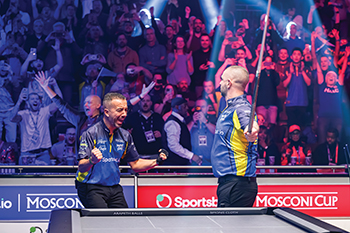 Alcaide and Shaw closed out the proceedings in a boisterous Alexandra Palace. It wasn't all pool, all of the time. Sometimes the group just spending hung out and talked, cooking meals for one another. They went to the movie theater. They flopped around in the water. The goal was for them to not only get to know each other's pool game but also each other as people, to build a bond that carries with them from the practice room to the table as they competed as a team in a game that is very much geared towards singular accomplishments. Getting individuals to gel into one unit isn't always an easy task, and Shaw wanted to make sure that when they left Scotland for London that he was traveling with one unit and not simply five individuals. “We are like family the last two weeks,” said David Alcaide, who was competing in his seventh Mosconi Cup. “We're not taking it lightly,” Shaw said. “We're here to do damage. I know what it takes to win, and I know the preparation that needs to be done. What I've seen the last couple of weeks, I'm sure we will be good to go.” The two-week bonding session more than paid for itself, as the European team swept the opening and closing days of play and handed the American team a lopsided 11-3 defeat in front of an Alexandra Palace crowd that has gotten accustomed to such dominance. The win was the sixth consecutive victory for the Europeans and the 17th overall since the event was created in 1994. Of those six consecutive wins, three of them resulted in the Americans only being able to tally three points and all of them felt like a European victory was a foregone conclusion, leaving American playing captain Skyler Woodward and Matchroom Multisport Chief Executive Officer Emily Frazer wondering what the fix is. While the results remained the same, so too did the makeup of the American team, as the United States made the decision to bring back the complete squad that was defeated by the Europeans in Florida last year, 11-6. Returning was the nucleus of playing captain Woodward, Billiard Congress Hall of Famer Shane Van Boening and two-time World Pool Champion Fedor Gorst, the Moscow native who emigrated to the U.S. in 2022 and has competed on the American team for the last three years. Also, again on this year's team was Billy Thorpe, who had a handful of top five finishes in 2025 — including fifth at the Peri Open and in the 9-ball division of the Derby City Classic. Rounding out the American team was Tyler Styer, who finished third at the UK Open and added a ninth-place finish at the International Open. “I think it helps us because we know each other,” said Gorst ahead of the event. “We don't have to spend time figuring out the doubles and we can just improve on what we did last year. The gameplan is to win and to not miss as many balls as we did last year.” The event, which was created in 1994 by boxing and snooker promoter Barry Hearn, has recently been borrowing from Matchroom's combat division by staging a pre-tournament press conference the day before the event begins — with the hopes that a little bit of instigation will lead to some lively banter between the teams. This year's media meeting started off light as they usually do: Joshua Filler talked about developing his cooking skills while Skyler Woodward discussed his squad doing a bit more training than they had last year, adding that Fedor Gorst had been given more control over the practice sessions leading up to this year's event. As a result, Gorst implemented a few of the practice drills that he had used to win two world champions and a U.S. Open 9-Ball Championship in his career. 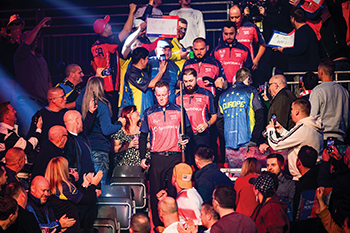 Team USA entered with hopes of turning the tables. “I don't remember if we did a drill last year,” said Woodward. “It's just a more disciplined practice because obviously Fedor has been under that his whole life whereas a lot of us Americans haven't.” “It's more structured this year, so I think we have a great chance,” said Thorpe. “We're learning. We didn't come from that kind of mindset in America. We were used to getting up there and just playing but there is obviously more to it than that, especially in an event this big.” But after the perfunctory discussions wound down, a few of the players took a few shots that weren't on the table. Jayson Shaw suggested that the teams be expanded to have six players, then alleged that American Shane Van Boening wanted Lukas Fracasso Verner on the team over Billy Thorpe, adding that he had seen a text message saying as much. “I think I am right where I belong,” responded Thorpe. The comment caused Styer to go on a 30-second retort, stating that the European players did not even want Filler last year due to his backing out of a commitment made with fellow players to boycott World Pool Association tournaments. Shaw had an answer at the ready for this as well. “You didn't want him on the team either because you can't beat him,” said Shaw. “Simple as that.” He also had an answer when the first day lineups were announced and Woodward said that his European counterpart had picked the wrong lineup. “Don't worry, pal,” said Shaw. “You'll see tomorrow when we drill you four nil.” 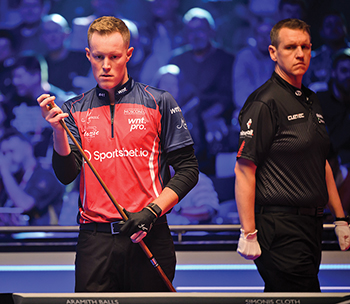 Snakebit Styer played himself to the brink of victory on three separate occasions, only to rattle the final 9 ball and subject himself to the mercy of the crowd. Day One As is customary, the event kicked off with the traditional five-on-five matchup. The Americans, dressed in their red and blue, entered the arena at the historic Alexandra Palace this Wednesday evening to the Dire Straits song “Money for Nothing” while the European team strode down the steps to the Oasis song “Roll with It” — two tunes that would prove to be clairvoyant by the end of the day. After winning the opening lag, Shaw got the party started for the Europeans with a break and run, that ended with him taking a lap in front of the crowd with his arms outstretched, essentially asking if they were entertained. They tacked another rack on thanks to a couple of sharp cut shots by newcomer Neuhausen before the Americans climbed onto the scoreboard. That would be the only rack that the Americans could muster, as Europe capitalized on a missed 9 ball in the fifth game by Thorpe following a series of circus shots to reach game ball, to win three straight and seal the set, 5-1. With the Americans in an early hole, Alcaide and Filler matched up against America's high-octane duo of Van Boening and Gorst, who jumped out to an early 2-0 lead thanks to a pair of Alcaide blunders in the opening games. The Europeans tied the score 2-2 and, after splitting the next two games, the European pair broke and ran in the seventh game, then used a safety to steal the set, 5-3. The come-from-behind defeat turned a potential tie into a 2-0 Europe lead, with Shaw facing fellow captain Woodward in the event's first singles matchup. The American won the opening lag, but the Scotsman used a successful jump shot on the 2 ball to snag the opening rack. After fluking in the 2 ball and slicing in the 3 ball, the American appeared to be positioned to tie the score but missed the 6 ball in the corner pocket and handed Shaw a 2-0 advantage. 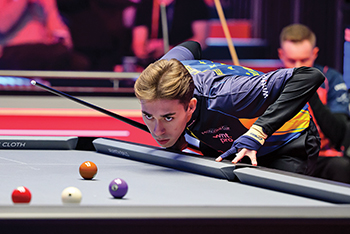 Upon closer inspection, MVP Neuhausen saw nothing to fear. “I missed,” he said after the match. “I really have nothing else to say. I came short on it, and I wanted to get more straight and I just missed. I didn't feel pressure. I didn't feel anything. I just twitched or something.” After the rack concluded, the Scotsman gestured to a member of the crowd who had been egging him on, with the two bantering back and forth for a couple of minutes before Shaw spoke with Matchroom officials and Gorst. After play completed, Shaw didn't elaborate, other than to say it was a part of a long running beef between him and the fan. “Yeah, someone was talking shit and has a big mouth and can't back it up,” said Shaw. “He's been doing it a while but I'm going to let it go and not do anything.” Woodward cut the lead to 2-1 when Shaw intentionally fouled by trying to tie up a pair of balls but even that came with some drama, as Woodward missed a shot on the 7 ball so badly that it banked down table into the opposite corner pocket. After Shaw responded by winning back-to-back games, Woodward used a safety to cut the lead to 4-2, but missed a bank shot in the next game to give the table back to Shaw, who ran out for a 5-2 win. Riding an early three-match streak, the Europeans sent out the rookie duo of Neuhausen and Libutis — a doubles pairing that Shaw said was the best he had on his team after observing them in practice for two weeks. Across the table sat Thorpe and Styer, who were looking to stop Europe from pitching an opening night shut out. Despite one passionate U.S. fan who loudly rasped out “rookies!” on every shot by the Europeans, the young pairing built a 2-0 lead, capitalizing on a missed 5 ball by Styer and a Thorpe foul in the following game. The Americans won two of the next three games to cut the lead to 3-2. With a chance to tie the score in the following game, Styer missed again and Europe increased its lead to two racks. Just when it appeared the Europeans were ready to clinch the match, Neuhausen missed, handing an open table to the Americans. Thorpe and Styer cleared down to the 9 ball, but facing a slight cut shot into the corner pocket, Styer missed and sent the crowd into a roar. The miss resulted in a straight in shot to the side pocket for Labutis, which he easily deposited for a 5-2 win and a 4-0 lead that felt a lot more commanding than it was given how the Americans performed. “We didn't feel any pressure,” said Neuhausen after the match. “There was still pressure, but it was a good pressure that you can use for a good time.” “I felt really comfortable playing doubles with him,” said Labutis, the first Lithuanian to ever compete in a Mosconi Cup. “I thought that the nerves would be bigger but it wasn't that bad. The atmosphere is cool and I'm looking forward to the next two days when hopefully there will be even more people and we have an even better time.” Major League Hall of Fame pitcher Dizzy Dean once said, “If you can do it, it ain't braggin'.” Well, Shaw's team did it, and he was happy to talk about it afterwards. “I'm just proud of the guys,” he said. “We came in with a mission and we're already into it a little bit. The plan was to win 4-0 and it worked out pretty well.” 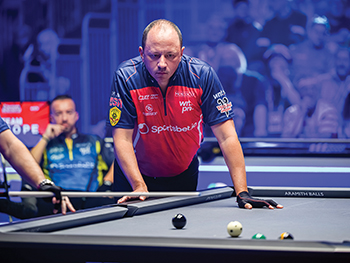 Van Boening played his best Mosconi Cup in years. Meanwhile, Woodward was left scratching his head after watching the worst-case scenario for the American team unfold over the opening four hours of play. “Well, I definitely didn't see it going that way,” said Woodward. “They still have to beat us seven more matches so I'm not sweating it. It's just that really only a few missed balls today is what beat us. It's day one of the Mosconi Cup. It's hard but, you know, it is what it is.” Day Two As the Americans entered the second day of competition, the pressure of earning the first point did not rest on any one man or pairing but instead the entire team, with play resuming with another five-on-five matchup. The Americans seemed energized by the night of sleep, taking advantage of consecutive fouls by Shaw and using a break-and-run to build an early 2-0 lead. After Neuhausen trimmed the lead to 2-1, the previously shaky Styer looked sharp in running out and pushing the American lead back to two games. The two teams traded the next two games to put the Americans on the hill for the first time in the event, but the Europeans tied the match at 4-4 thanks to a Filler break-and-run and a misplayed safety by Woodward. Europe's hopes of coming from behind rested in the hands of Alcaide, who immediately forfeited the table to Styer when he failed to land a ball on the break. The Wisconsin native methodically worked his way through the rack, reaching the 8 and 9 balls, which were positioned near the same corner pocket. Just when it appeared that Styer was about to earn redemption for his first day's play, he failed to land the desired cue ball positioning on the 9 ball, then missed a bank shot into the side pocket. The crowd once again roared. Faced with a table length straight in shot on the game-winning ball, the Spaniard slowly rolled the striped ball down table and into the pocket to secure the win, 5-4, sending the crowd to its feet and keep the shut out alive. Having just squandered their best chance to secure a point, the Americans path did not get any easier in the next match when Gorst faced his old rival Filler, who used a couple of safeties and Gorst miss to build a fast 3-0 lead. After the American tacked back-to-back games on to trim the deficit to 3-2, Filler broke and ran to keep the pressure on the American. Gorst retaliated by sinking the 9 ball on the break in the following game. The two engaged in a safety exchange after Filler broke in the eighth game, but the German ended any hopes of a comeback when he used a jump shot to knock the ball in, then landed a combination shot on the 3 and 8 balls to run out and secure the match, 5-3. Filler wasn't finished for the night, playing in the very next match with Shaw against Van Boening and American captain Woodward. For nearly a decade, the pairing of the Scotsman and the German has evolved into one of the most dominant and engaging duos in Mosconi Cup history, and when they broke and ran to open the race-to-five set, it appeared that another commanding performance could be under way. That was until the American pair rolled out a break-and-run of their own, then added a victorious safety exchange. They added another break-and-run and then capitalized on a dry break by Shaw to take control of the match, 4-1. The Europeans added a rack when Woodward fouled in the sixth game but a missed 4 ball by Shaw in the following game allowed Van Boening to bank the ball the length of the table and the Americans finally earned a victory, 5-2. 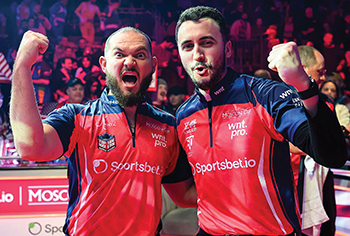 Thorpe (left) acquitted himself well, teaming with Gorst (right) for a win. “It was a big relief,” said Van Boening of finally getting the American team on the scoreboard. “It wasn't easy because you're playing one of the two top players in the world, so we had to do everything that we can. I pretty much played perfect in the match. Other than that, I'm happy to just get the point.” “Shane and I always play well together so you're definitely going to have to play well to beat us in a race-to-five,” said Woodward. “We're just going out there every match and trying to win and we finally got one.” After America finally climbed onto the board, the decision was made to shut down play early and push the remaining two scheduled matches to the third day of play — a decision that did not sit well with many of the fans who had paid for tickets. With the Europeans already holding a 6-1 lead, Matchroom was looking to preserve a decent amount of play for spectators for the remaining two days. “I think that I've learned over the years that you can't control everything,” said Frazer. “And at the end of the day, I'm not the one out there on the table having to make those shots in that arena. And I think that is the beauty of live sport. I think it is just one of those things that we learn with our jobs that we just have to adapt quickly, and we've just got to make sure that we deliver four world class days of an event.” Day Three Opening the third day of play trailing 6-1, the event commenced with a singles play match between the snakebit Styer and the rising star Neuhausen, who took advantage of a scratch by the American to snag the opening rack. Styer appeared rattled early on, struggling to secure cue ball positioning after making the 1 ball in that first rack and ultimately missing the 4 ball before the scratch. Although he looked as comfortable as a root canal throughout, he seemed to gain his composure as the match progressed, using a two-rail kick to pocket the 2 ball and run out to tie the score, then running out the next rack after the German failed to pocket a ball on the break, and using a successful safety exchange as well as a bank shot on the 7 ball to clear the table and secure a 3-1 lead. Neuhausen wasn't finished, though, using a safety exchange of his own to trim the lead to 3-2, then trading break-and-runs to maintain a one-game deficit. The German tied the match at four games each with a jump shot on the 2 ball that allowed him to clear the table. With the crowd now cranked up over the match being sent to a deciding rack, Neuhausen banked in the 2 ball but, with the path to the 3 ball blocked, he went and grabbed his jump cue again. This time, the object ball rattled in the pocket's jaws and stayed on the table, allowing Styer a chance to steal the set. As he worked his way through the rack he left an odd angle on the 8 ball, which he made and left himself a sharp cut shot on the winning 9 ball. The crowd loudly jeered, and Styer accommodated by again missing a match-clinching 9 ball. The partisan fans were still hooting when Neuhausen tapped in the winner to give the Europeans a 7-1 lead. Although many American fans complained that Styer was sharked by the crowd noise, the American wasn't hearing any of it. “People think the referee should have quieted them down. I actually disagree,” said Styer in an interview with Matchroom the following day. “I think that's what the event needs. I think the more exposure you can get, the better. The purists may not like it but to grow the game I think we need that.” Needing a quick reversal of fortunes, the U.S. squad turned to Gorst and Thorpe against rookie Labutis and the veteran Alcaide. Thorpe built his reputation early in his career by being one of the best bank pool players in the game, having won the bank pool ring game at the Derby City Classic three times and winning the banks division in 2019. After his week of play in London, he may want to change his nickname to “Kickin' Billy,” as he opened the match by kicking in the 2 ball to help him and Gorst run out and grab an early 1-0 advantage. In response, Thorpe let loose with a high leg kick for the crowd after making the shot. “I think that I kicked in every single ball that I tried to kick in so I just did the Bruce Lee and kind of let it out,” said Thorpe. “With Billy you just have to let him shoot his shot,” Gorst said. 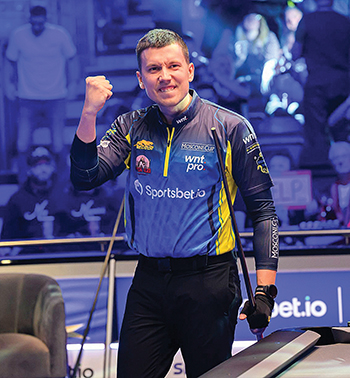 Lithuanian Labutis enjoyed a pressure free Mosconi Cup. The Americans won two more games to build a 3-0 lead, thanks to a successful combination shot on the 9 ball in the second game and an Alcaide miss of the 2 ball in the following game. The Europeans cut the lead to 3-2 when Thorpe failed to pocket a ball on the break in the fourth game and Gorst missed in the following rack. And when Gorst scratched on the break in the sixth game it appeared the Americans were on their way to squandering another lead. That was before Labutis missed a combination shot that allowed the Americans to steal the rack. Labutis made the 9 ball on the break to cut the lead to 4-3 but missed a bank shot on the 3 ball in the following game, allowing allowed Gorst and Thorpe to seal the victory, 5-3. The win and the pairing was a breath of fresh air for the American team, with the native Ohioan and Russian expatriate who now lives a few miles away in rural Indiana playing and acting like old friends. “I was a little hyped up today,” Thorpe understated. “We have nothing to lose at this point. We needed to try something different, and I wanted to be a little more energetic and happy to be here rather than stressing every single shot. I wanted to let it out and it kind of worked out for us.” So how do they work as a team with Thorpe being the devil-may-care risk taker while Gorst takes a more methodical approach? “Like dumb and dumber,” said Gorst. “Yeah, we're definitely riding home on a moped tonight,” said Thorpe. Still trailing, 7-2, the Team USA looked to keep the momentum going in the five-on-five team competition, with Billiard Congress of America Hall of Famer Van Boening breaking and running to open the scoring then Gorst adding to the lead with a run out after Shaw scratched on the break. Undaunted, the Europeans rattled off four consecutive racks, thanks to successful safety play by Filler in the third game and a missed 3 ball in the following rack by Woodward. The Americans rallied to tie, with Gorst breaking and running in the seventh game to cut the deficit to 4-3 and Styer taking advantage of a Filler foul in the eighth game. The match came down to the ninth game, with Woodward having the deciding break. After he failed to make a ball, he won a safety exchange and worked his way through the rack. When he reached the 6 ball, he was faced with a long, sharp cut shot that forced him to use the rake and try to nudge the ball past a 9 ball that was near the corner pocket. He feathered the shot and watched as it failed to run far enough to drop. Instead, it was the Europeans who cleared the table and celebrated a 5-4 win and an 8-2 lead. With the Americans' chances of clawing their way back into the event starting to look bleak, they turned to Van Boening, who matched up in a singles match against the Spaniard Alcaide. The five-time U.S. Open champion jumped out to an early 2-0 lead, forcing Alcaide into a foul in the opening game then capitalizing on a scratch on the break by the European in the next game. After Alcaide climbed onto the scoreboard in the third game, Van Boening used a one-rail kick on the 2 ball in the fourth game followed by a break-and-run to build a 4-1 advantage. After Alcaide cut the deficit to 4-3, the American closed the door for good, using a successful push out after the break to run out and secure the set, 5-3 and cut the deficit to 8-3. Although five matches were scheduled for the day, the decision was again made to end play early in order to guarantee at least three matches for the fourth and final day of play. Day Four The Americans entered Saturday evening with a bit more optimism thanks to their play the day before, having had a legitimate chance to win all four matches before ultimately splitting the play 2-2. Win the first two matches on the final day, they thought, and pressure might shift to the Europeans. When the doubles pairing of Gorst and Woodward opened play against Filler and Neuhausen with the former World 9-Ball champion executing his own successful kick in of the 3 ball — followed by his own leg kick — and running out, then capitalizing on a Neuhausen scratch to build a 2-0 lead, it appeared that their best hopes for the day might be taking place. Then Neuhausen won a safety exchange on the 3 ball in the third game, Woodward missed a sharp cut shot on the 3 ball in the following rack and missed a 9 ball in the next game that would have given the Americans back the lead. The German duo won five straight to close out the match, 5-2. 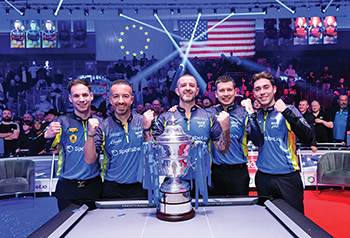 For the sixth straight year, Team Europe was at the table for the trophy ceremony. Trailing 9-2, Thorpe tried to stop the bleeding when he met Labutis, who took advantage of a Thorpe foul to climb onto the scoreboard, then capitalized on a scratch on the break by the American along with a successful safety in the fourth rack to win three of the first four games. Thorpe cut the lead to 3-2 after a safety exchange and had a chance to tie the score but missed a long combination. The Lithuanian cleared the table to build a 4-2 lead but a miss in the next game allowed Thorpe to trim the deficit to a single game. Any hopes of a Thorpe rally were dashed in the next game when Labutis broke and ran to secure a 5-3 decision and move the Europeans a point away from another victory. The last hopes of the U.S. rested with Styer and Van Boening, who met Alcaide and Shaw in a must-win match. Things looked promising for the Americans early, as a missed 4 ball by Alcaide in the opening game and a scratch by Shaw in the following rack allowed them to build a 2-0 lead. But much like the previous matches throughout the week, unforced errors began to catch up with them, like when Styer rattled a 4 ball in the third game, allowing Europe to crawl onto the scoreboard. Then, a missed 2 ball by Van Boening resulted in Shaw and Alcaide tying the score and surge ahead in the next game when Styer missed. After Shaw used a billiard on a hanging 9 ball to push the lead to 4-2, the crowd at Alexandra Palace launched into an anticipatory roar. Down to their last chance, American hopes were dashed when Van Boening missed in the next game. Working in tandem, as they had for the two weeks in training in Scotland, Shaw and Alcaide picked off the final balls. When Alcaide made the 8 ball and rolled the cue ball into perfect position for the match-winning 9 ball, he walked over to Shaw and gave him a kiss on the cheek. Shaw deposited the 9 ball and the European team was again dancing, this time on top of the nine-foot Rasson pool table that they had earned their commanding victory on. “The goal for today was stick to the plan and finish the job,” Shaw said, “The whole goal was to go out there and get the job done.” Neuhausen capped off a year in which he had already won two large professional events and qualified for both the Reyes and Mosconi Cup by winning the event's Most Valuable Player — the Mika Immonen MVP Award. Matchroom renamed the trophy to honor the late Hall of Famer, who competed as a member of the European team 15 times and earned MVP twice. Nuehausen earned the award by posting a 2-0 record in doubles play and winning his lone singles match. “I don't think I was the best player, I think overall the team deserves this trophy,” said Neuhausen. “I'm super happy to have it but I think Josh deserves it. I just wanted to see how I would perform under pressure, and I think I proved myself quite well. We all tried our best. It was all about the team.” “I came back strong,” said Filler. “I think I played the best Mosconi Cup that I ever played but with the team behind me that was the only way it could be. Even David made me cry with something he said.” Meanwhile there was a different type of crying on the American side as they — and most likely Frazer — will head into 2026 with one pressing question on their mind: How do we narrow the gap? It's a question Frazer mulled at the end of each evening. She knows it won't be an overnight fix but also recognizes that the status quo isn't working. “I have no idea I just know that we need to do something,” she said “We need to mix it up. We need change it up and I don't know what that answer is yet. I'm not denying that something needs to change.” |
|
Since 1978, Billiards Digest magazine has been the pool world’s best source for news, tournament coverage, player profiles, bold editorials, and advice on how to play pool. Our instructors include superstars Nick Varner and Jeanette Lee. Every issue features the pool accessories and equipment you love — pool cues, pool tables, instruction aids and more. Columnists Mike Shamos and R.A. Dyer examine legends like Willie Mosconi and Minnesota Fats, and dig deep into the histories of pool games like 8-ball, 9-ball and straight pool.
Copyright © 1997 - 2025 Billiards Digest
All Rights Reserved
Luby Publishing, Inc.
310 Busse Highway PBM #319 | Park Ridge, IL 60068
Phone: 312-341-1110 | Fax: 312-341-1469