


|
|
|
| HomeAbout Billiards DigestContact UsArchiveAll About PoolEquipmentOur AdvertisersLinks |
|
Browse Features
Tips & InstructionAsk Jeanette Lee Blogs/Columns Stroke of Genius 30 Over 30 Untold Stories Pool on TV Event Calendar Power Index |
Current Issue
The Fall and Rise of Jiaqing Wu Chinese star breaks the bank with $1.5 million top prize at the Duya Golden Nine Legends Global Final in Beijing. By Mike Panozzo StraightBlack and gold confetti rained down from the rafters of the dazzling, packed Blue Gem Arena in Beijing, China, in early July, showering the champion of the Duya Golden Nine Legends Global Final and winner of the largest top prize ever awarded in pool — $1.5 million! And if the pool gods could ever be credited with doing the right thing, they could be applauded on this day because that champion, standing tall on the Duya Gold table with the massive gold trophy held high in his right hand, was 37-year-old, two-time World Pool Association World Champion Jiaqing Wu. Wu, born in Taipei but a resident of China since 2011, had just completed a dominant run through the arduous and complicated group stages and finals bracket, eventually topping countryman Xiaohuai Zheng, 140-82, in the title match. As Zheng conceded the match, Wu was stoic and composed in being proclaimed champion, instead hugging his opponent and directing the crowd's attention to Zheng as a worthy combatant. He slowly walked back to his chair to collect his cues as if he had to move to another table for his next match. It wasn't until the humble champion was asked to address the audience that Wu's emotionless façade began to crack. “Today, I feel incredibly fortunate to make a lifelong dream come true,” he said. “To compete in a tournament with a champion prize of 10 million RMB. This is a milestone I will cherish forever.” Then, his voice cracking and eyes welling up, Wu paid honor to his late grandmother, whom he called “Ama,” who raised him and bought him his first cue. “Today is also a deeply emotional and special day for me,” he said. “It is my grandmother's second anniversary in heaven.” The Duya Global Finals is the marquee event of the five-tournament Duya Legends Tour, a series of events from promoter and billiard equipment manufacturer Duya. The tournaments are played on 9-foot Duya Chinese 9-ball tables — essentially 9-foot snooker tables, with rounded pocket openings and napped cloth. According to WPA President Ishaun Singh, the five Duya “station” events, with four boasting $800,000 purses and the Global Finals, which had been $1.5 million before this year. 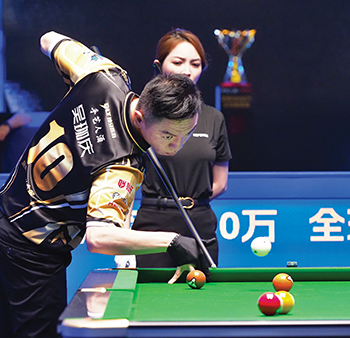 Originally billed as a $1.5 million total purse, with $750,000 going to the champion, the 2026 Duya Global Finals received last-minute sponsorship from Chinese liquor company Shouyiren. Shouyiren dropped an additional $750,000 into the prize fund, with the stipulation that the entire amount be added to the top prize. Already a top-heavy payout, the winner would now receive $1.5 million — 65 percent of the total purse. The matches utilize Duya Golden Nine rules, with matches decided by points rather than games won. A player earns 10 points for a break and run, seven points for a run out following a dry break, golden break or combination on the 9, and four points for a multi-inning rack win. Players also earn a point if their opponent fouls. While matches are a set number of total games, they also have time limits, and the time often runs out before the full number of racks are played. Whichever player is leading in points wins the match. According to Singh, the WPA is in the process of approving Golden Nine has an official discipline, alongside 8-Ball, 9-Ball, 10-Ball, 14.1 Continuous, Blackball, Heyball, Pyramid and Artistic Pool. Typical of large, Chinese-promoted Duya and Heyball tournaments, the field is split in two, with international players playing two stages to reduce 196 players to 32 for single elimination. At that point, the top 32 players from the Chinese division join the fray for the 64-player knockout stage. The international field in Beijing was headlined by world pool champions Pin-Yi and Ping-Chung Ko of Chinese Taipei and Dennis Orocllo of the Philippines. With the Duya tour offering big money and the opportunity to play exclusively in Asia, the Ko brothers dropped out of the World Nineball Tour midway through 2025 to concentrate on Chinese 9-ball. In fact, the brothers met in the title match of the Duya Legends Golden Nine Masters in the spring, with Pin-Yi winning but the pair sharing $350,000 for first and second place. All three American pool stars reached the single-elimination final 64, as did WNT major winner Mickey Krause and Spain's Jose Alberto Delgado. Only Pin-Yi Ko (ranked No. 4 on the Legends Tour) advanced, losing to 2025 Duya Global Finals winner Bingjie Chu in the quarterfinals after missing a late rack bank shot with time running out and victory within reach. Still, Ko picked up $27,000 for fifth place. 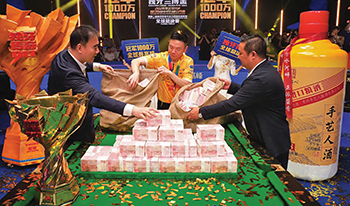 Piling on! Wu needed a hand with his 10 million Chinese Yuan haul. In the end, however, it was the lethal Chinese contingent that dominated the late stages. All four semifinalist were Chinese — Wu, Zheng, Chu and Long Zhou. In one semifinal, Wu posted a 108-84 win over Chu, completing 34 of 40 scheduled games. Meanwhile, Zheng earned his spot in the finale with a win over Zhou. No one was going to stop the single-minded Wu, who reportedly trained in secrecy for 45 consecutive days prior to the Global Finals with fellow Chinese player Zhenqi Xue. (Xue also reached the final 64.) In the title match, Wu unleashed five runouts from the break, as well as a golden break and a table run following a dry break from Zheng. But never mind that this was “Chinese 9-ball.” Wu's finish struck home for many fellow pros and followers of the American cue games. Wu holds legendary status in the American pool world despite an enigmatic career that has been defined by jaw-dropping displays of brilliance at the table and long periods of absence away from it. “For me, Wu is one of the top three or four players I've ever played against,” insists multiple world champion and Billiard Congress Hall of Famer Darren Appleton. “Maybe top two when it comes to rotation games. His cue action is so smooth, and he has great temperament and beautiful timing and tempo. He hits the ball so good that everything looks easy to him. That's the best compliment I can give a player. On top of everything else, he's a super nice guy.” “It's hard to play at your normal level against him,” added Pin-Yi Ko, another multiple world champion and one of Wu's early contemporaries in Taipei. “You feel a lot of pressure without even realizing it.” It's the talent that took the pool world by storm in 2005, when Wu, then barely 16, broke and ran the deciding rack against fellow Chinese Taipei player Po-Cheng Kuo to win the WPA World 9-Ball Championship. Six months later, Wu defeated Nick van den Berg of the Netherlands in the United Arab Emirates to claim the WPA World 8-Ball Championship, becoming the first player to win two WPA world titles in the same year. 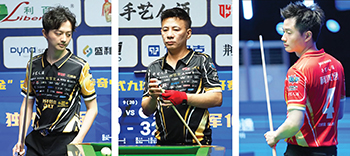 American pool world champions Ping-Chung Ko, Dennis Orcollo and Pin-Yi-Ko were in the mix. Then began a series of events that resulted in one speed bump after the next for the talented left-hander. First came disputes with the national federation in Chinese Taipei in 2008 (the details of which are not clear), which resulted in a two-year ban from competition. As quick as Wu's rise to stardom was, his disappearance was equally rapid. In 2011, Wu moved to Shenzhen, in the southeastern part of mainland China, and joined the country's billiard system. A year later, while doing military service, Wu reportedly was diagnosed with chronic leukemia and was discharged. The illness left him unable to play for several more years. By the mid-2010s, Wu was once again popping up at events in Asia, winning the Chinese Pool and Billiard Association International Championship in 2015 and the prestigious China Open in 2016. In 2018, Wu made a triumphant return to the global stage when he teamed with Haitao Liu to win Matchroom's World Cup of Pool in Shanghai. Wu and Liu put on a dominant performance in the title match, crushing Austria's Albin Ouschan and Mario He, 10-3. A year later, Wu was in Las Vegas for the first Matchroom-run U.S. Open Pool Championship. It was vintage Wu, as the Chinese star cruised to the finals on the heels of a 10-7 win over Shane Van Boening, an 11-0 whitewash of Wang Can and 11-5 win over Yu-Lung Chang. In the finale, Wu matched Joshua Filler ball for ball, at the table trailing 12-10 when his bridge hand slipped while setting up and a finger touched the cue ball. Filler finished out the match, but international pool fans had once again been treated to one of the world's great cueists. 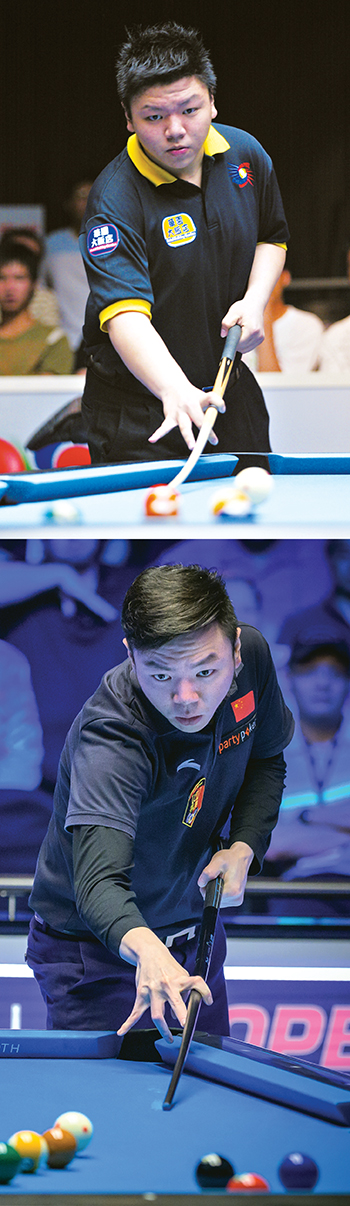 From 2005 (top) to 2019 (bottom), Wu has been a force in American 9-ball events. In 2019, Wu once again won the China Open. But with increased opportunity and fat prize funds, Chinese 8-ball and 9-ball beckoned, and Wu has opted to stay in Asia and almost exclusively China. Fans — and competitors — of the American pool games can only hope that the window once again opens for Wu in international events. But few would begrudge the likeable Wu opportunities to put his talents on display for million-dollar paydays. Most would agree: this time, the pool gods got it right. |
|
Since 1978, Billiards Digest magazine has been the pool world’s best source for news, tournament coverage, player profiles, bold editorials, and advice on how to play pool. Our instructors include superstars Nick Varner and Jeanette Lee. Every issue features the pool accessories and equipment you love — pool cues, pool tables, instruction aids and more. Columnists Mike Shamos and R.A. Dyer examine legends like Willie Mosconi and Minnesota Fats, and dig deep into the histories of pool games like 8-ball, 9-ball and straight pool.
Copyright © 1997 - 2025 Billiards Digest
All Rights Reserved
Luby Publishing, Inc.
310 Busse Highway PBM #319 | Park Ridge, IL 60068
Phone: 312-341-1110 | Fax: 312-341-1469