

|
|
|
| HomeAbout Billiards DigestContact UsArchiveAll About PoolEquipmentOur AdvertisersLinks |
|
Browse Features
Tips & InstructionAsk Jeanette Lee Blogs/Columns Stroke of Genius 30 Over 30 Untold Stories Pool on TV Event Calendar Power Index |
Current Issue
A Step-by-Step Guide to 8-Ball The evolution of the break cue added another club to players' bags, and an entirely new category to the offerings of manufacturers and dealers. By Keith Paradise If 9-ball is a game of connect the dots — the 1 ball leads to the 2, the 2 leads to the 3, and so on — 8-ball is more like a choose-your-own adventure book. Once you choose stripes or solids, you're faced with literally thousands of possible ways to work your way through all seven object balls before getting to the 8. 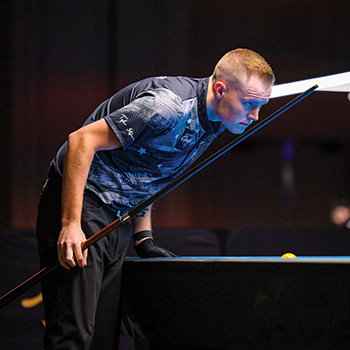 With an open table offering so many possibilities, there's no single right answer. Plans can change from shot to shot — and you can ride different routes to a W. To that end, Billiards Digest spoke to American stars Skyler Woodward, Tyler Styer and Sam “Ryno” Henderson to have them walk us through an actual game of 8-ball from a recent match. From a relatively straightforward clearance from Styer to Woodward's nervy match-clinching break-and-run, these case studies are intended to offer folks of lesser ability a view inside the mind of a pro. Roadmap to Victory Player: Tyler Styer Event: Ultimate Pool League Iowa Open Location: Clive, Iowa Date: March 15, 2026 The Set-Up: This rack took place in the quarterfinals of the Ultimate Pool League's Iowa 8-Ball Open, which was a race-to-7 on a 40-minute clock played on a 7-foot table. At the start of the sixth rack, Dennis Hatch held a 3-2 lead. The Break: Hatch drilled the rack, pulling the cue ball back toward the center of the table, but it was then kicked two rails into the side pocket, giving Styer ball in hand. First Thoughts: According to UPL rules, after a scratch on the break, the incoming player gets ball in hand behind the headstring, though all balls are open to play. Surveying the table, as shown in Figure 1, Styer immediately clocked stripes as a tricky proposition. “The 15 ball [on the long rail] was a problem, with the 7 ball near the corner pocket,” he said. “But one of first thoughts in looking at the table is seeing where the 8 will go.” 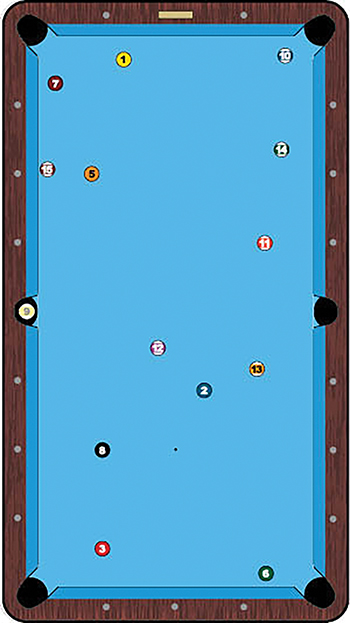 In this scenario, the bottom left looked like a natural destination from the game ball, so he started building his route to victory backward from the 3. “I knew I wanted to play position off the 3 for the 8,” he said. “It offered the easiest position, with all the other balls relatively open.” Still, Styer pointed out that the 2 ball could be a bit of a sneaky problem. “With a ball like that, out in the middle of the table, it can be more difficult than you might think,“ he said. “Playing position on the 2 isn't as easy as it looks.” The Plan: “I started with the 5 ball so I could then play the 7 and the 1,” he said. “In this situation, there weren't a lot of problems, so I wanted to keep the cue ball from moving too much.” As shown in Figure 2, Styer punched the 5 ball to the lower left corner, letting the cue ball move toward the head spot for the 7 in the same pocket. From there he let the cue ball drift out for an angle on the 1, which would then allow him to get shape on the 4. 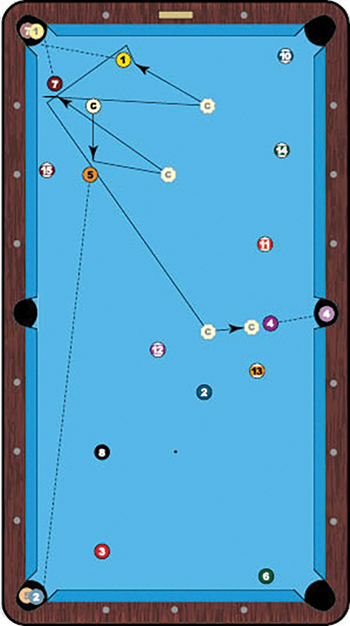 “I knew the key shot was going from the 1 to the 4, because I needed to be in perfect shape for the 2 ball [in the lower left corner],” he said. “If I could on the 4, I knew the rack was pretty much over.” As he pocketed the 7 to get into position for the 1, he had a little less of an angle than ideal. But that just changed his path to the 4 ball — instead of going off the headrail and straight down table, he would force the cue ball forward, playing two rails to the 4. “In some ways, it was better to go two rails, because I had a better angle getting in line with the 4,” Styer said. “Going [off the long rail] put the cue ball a little closer in line to the 4.” With perfect speed, he punched the 1 into the corner, watching as the cue ball floated toward center table, nearly perfectly in line with the 4 and the side pocket. From there, it was elementary, with his route to victory shown in Figure 3. A stop shot on the 4, rolling forward for the 6 in the corner, and then going one rail for the 3, he easily got shape on the 8 to win the rack. 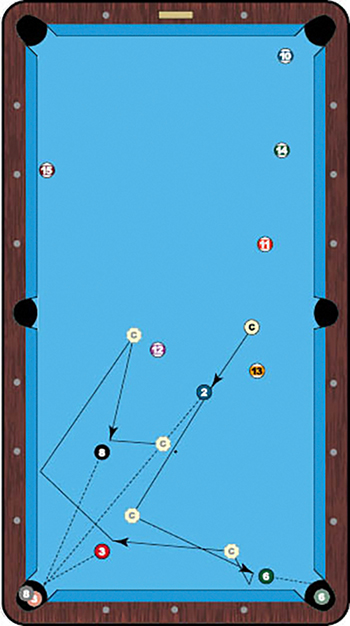 Making It Look Easy (Even When It's Not) Player: Sam Henderson Event: Ultimate Pool League National Shootout Location: Cherokee, North Carolina Date: November 12, 2025 The Set-Up: In the round of 32 in the 256-player UPL National Shootout, up-and-coming Sam “Ryno” Henderson was facing Styer in a race-to-6 on a 7-foot table. The Break: Here, Henderson broke open the fifth rack with a punchy stroke that sat the cue ball near the center of the table, though it was then kicked toward the top left corner. A bit of an unlucky roll, with the cue ball nearly frozen to the 3 ball, as shown in Figure 1, he didn't have many options after pocketing both a solid and a stripe on the break. 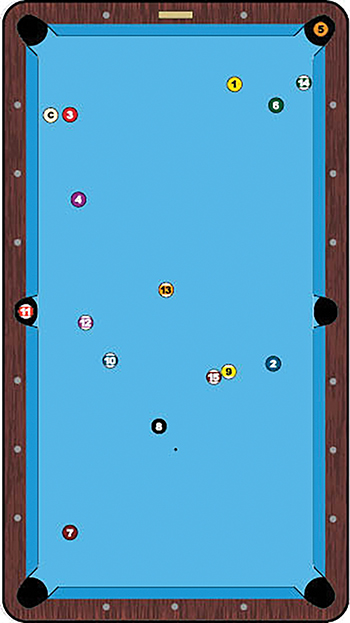 First Thoughts: “I really didn't have another option [than the 7 ball in the bottom left corner],” Henderson said. “It wasn't that tough of a shot, and I had a natural angle to play position toward the center of the table.” The three balls sitting near the top right corner, though, seemed like something that would have to be dealt with eventually. “I wasn't sure if the 6 ball would go [in the corner pocket], so my first thought was to pocket the 1 ball off the 14 to open it up,” he said. The Plan: Like so often in 8-ball, the initial plan didn't quite work out. Pocketing the 7 ball, Henderson sent the cue ball into the 2 near the side pocket when he planned to send the cue ball above it for position on the 3, which would then open up the corner for the 4. (See Figure 2.) 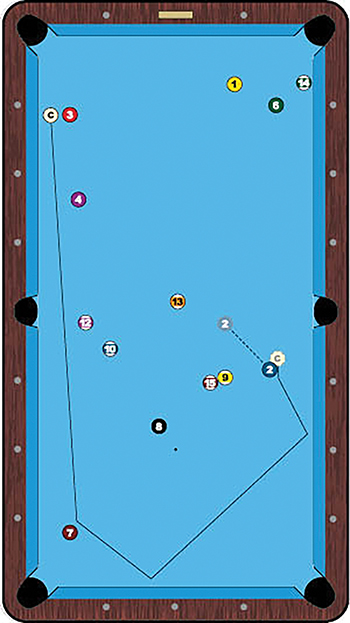 “The angle just kind of flattened out on me,” he said, of the cue ball after it hit the bottom rail after sending the 7 into the corner pocket. “That was my first match on that table — and it was playing really fast.” But that detour opened up an opportunity, as he surveyed the new table (shown in Figure 3) and saw that the 6 did go in the top right corner, even if only half the pocket was available to him. 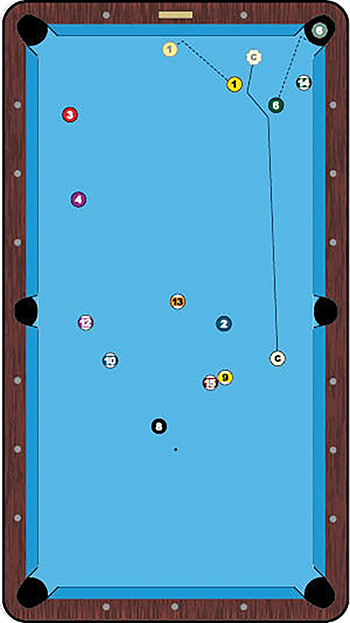 “I knew I could play the cue ball into the 1,” Henderson said, “and that would give me a shot [on the 1] into the other side pocket. And even if I missed the 6, I would block Tyler's 14 ball. It was kind of a two-way shot.” Without much of an angle on the 1, he intended to pop the cue ball off the headrail and straight out to the head spot for an angle on the 3 ball into the top left corner. But the cue ball didn't respond as planned, stopping just a diamond from the short rail, even the 3 ball. 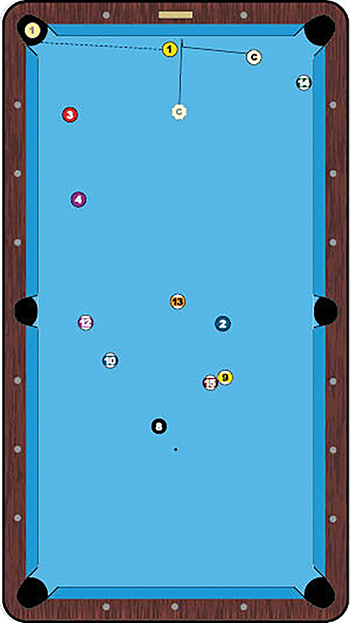 Faced with a choice between a long, nearly straight angle on the 2 and a three-quarter table cut on the 4, Henderson opted for more difficult shot now in hopes of a delayed benefit. “I knew I wanted to use the 2 ball to get on the 8,” he said. “If I cut the 4 ball, I could play position toward the center of the table for the 3.” That calculus paid off. He sank the tricky 4 ball, which opened up his last two solids. Dropping the 3 in the top left corner, he then had a slight angle on the 2 ball into the bottom right for shape on the 8. But that position play, shown in Diagram 5, also didn't go exactly as planned. 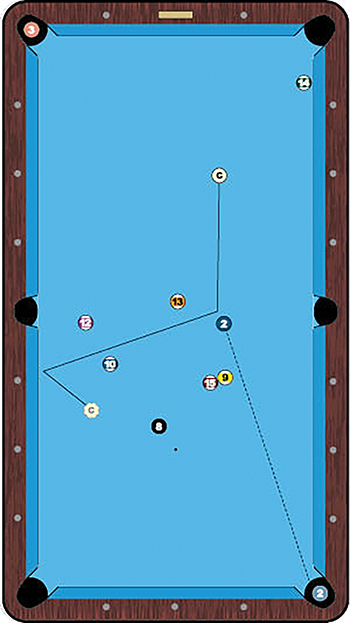 “I wanted to play the cue ball into the 13 for position on the 8,” he said. “But I went between the 10 and 12 and ended up with an angle on the 8.” Despite the steep angle, Henderson cleanly pocketed the 8 to win the rack. “[The rack] didn't really go like I planned,” he said. “But that's how it is sometimes. It might look like someone meant to do something even when they didn't.” The Importance of Improvisation Player: Skyler Woodward Event: Yalin WPA World 8-Ball Championship Location: St. Louis, Missouri Date: April 5, 2026 The Set-Up: In qualification play at the 2026 Yalin WPA World 8-Ball Championship, both Woodward and Carlo Biado won their first matches, so this race-to-8 meant the winner would advance to the knockout stage. On a full-size 9-foot table, the American worked his way to the hill, 7-4, against the freshly minted BCA Hall of Famer. The Break: Breaking a ball's width from the second diamond on the right rail, Woodward pounded the head ball, with the cue ball sticking to the center of the table before the 15 kicked it to the position shown in Diagram 1. 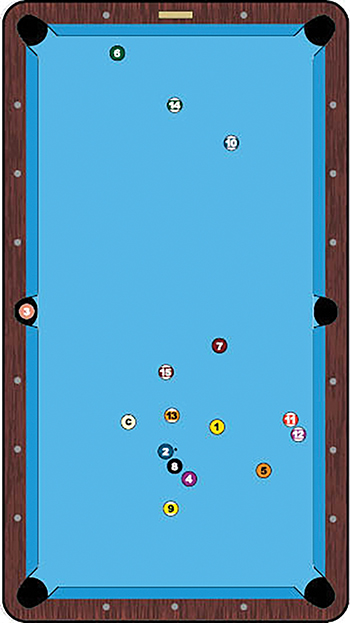 First Thoughts: For a solid break, Woodward wasn't left with much. “Really, I didn't have a choice [between stripes and solids],” he said. “There wasn't really a shot on a solid, so I knew I'd go with stripes. “My first thought was the 11-12 cluster on the rail. You always want to deal with problems as early as you can in 8-ball, so I knew I had to break those balls up. The 15 gave me a nice angle into them, so that was where I wanted to start. I thought if I didn't have a shot on either of them, the 9 ball might be an option too.” The Plan: There wasn't much of a plan, besides addressing the cluster at the start. Sending the cue ball from the 15 into 11, shown in Figure 2, Woodward kept the cue ball above both object balls. The resulting position left the 12 available to the lower right corner, but the 11 was in the way for now. The 9 ended up not being an option, so he cut the 13 ball into the bottom left corner, playing the cue ball up-table for position on either the 10 or the 14. 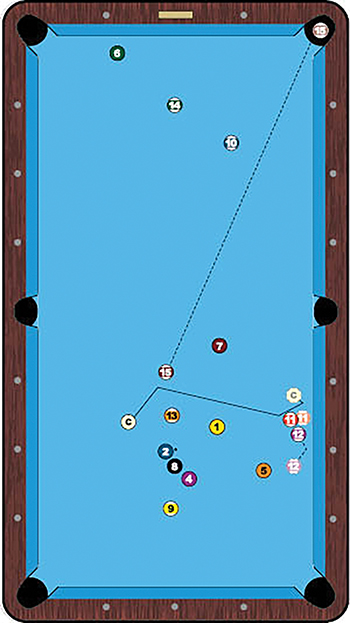 Sinking the 13 but putting the cue ball near the 10 (Figure 3), he next had to play the 12 in the bottom corner. But again, things didn't go as planned. 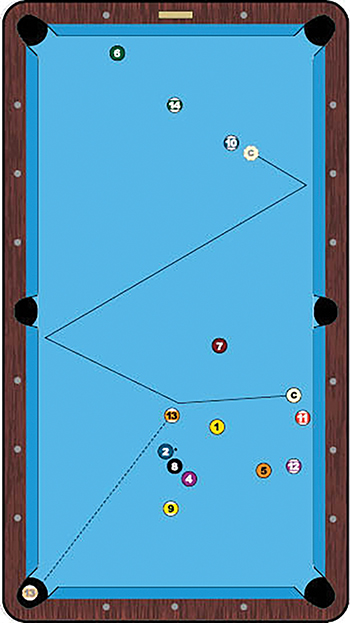 “I wanted to roll forward for the 9,” Woodward said. “I just kind of came up short.” With the 5 ball blocking a path to the 9, he then played the 11 ball up-table into the top right corner. From there, the 9 gave him position on the 10, which left him with an angle on the 14. A tricky shot on the key ball, shown in Figure 4, Woodward needed to send the cue ball into the headrail and down-table, playing the correct speed to get a look at an 8 ball that was surrounded by solids. 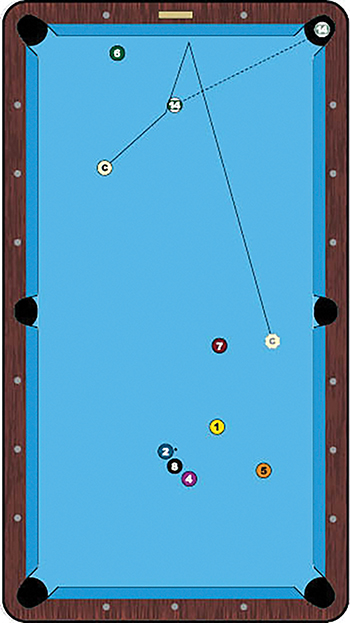 “I wanted to get between the 1 and 7,” he said. “I just had it in my head that that was the right way to go. But it might've been easier to get between the 1 and the 5.” Either way, he came up behind the 1 — meaning an especially nervy rack all ended up with a jump shot on the 8. Without hesitation, he pulled out the short stick, called his pocket, cleared the 1 ball, and landed the cue ball on the 8, which went straight into the corner pocket to win the match. “I hadn't made a jump shot that whole event,” Woodward said. “That's why I celebrated a little after that shot. It wasn't because I won — I mean, I was glad I won — but it was because I finally made a jump shot for once.” |
|
Since 1978, Billiards Digest magazine has been the pool world’s best source for news, tournament coverage, player profiles, bold editorials, and advice on how to play pool. Our instructors include superstars Nick Varner and Jeanette Lee. Every issue features the pool accessories and equipment you love — pool cues, pool tables, instruction aids and more. Columnists Mike Shamos and R.A. Dyer examine legends like Willie Mosconi and Minnesota Fats, and dig deep into the histories of pool games like 8-ball, 9-ball and straight pool.
Copyright © 1997 - 2025 Billiards Digest
All Rights Reserved
Luby Publishing, Inc.
310 Busse Highway PBM #319 | Park Ridge, IL 60068
Phone: 312-341-1110 | Fax: 312-341-1469