

|
|
|
| HomeAbout Billiards DigestContact UsArchiveAll About PoolEquipmentOur AdvertisersLinks |
|
Browse Features
Tips & InstructionAsk Jeanette Lee Blogs/Columns Stroke of Genius 30 Over 30 Untold Stories Pool on TV Event Calendar Power Index |
Current Issue
Against All Odds Legendary action king Keith McCready is still around, recalling the glory days of life as one of the game's true characters. By Michael P. Geffner Photos by Pete Marovich It is 10 in the morning, a time when he used to be going to bed, but these days Keith McCready is having his first coffee of the day, a prepared hazelnut mix out of a tin, followed by blueberry pancakes topped with gobs of butter. In a short while, flopped in his Lazy-Boy, a pillow under his knees, his dog Ducky curled at his feet, he is glued to his iPhone, texting and chatting with old friends, playing online poker, and watching ESPN, studying the sports scene, every sport imaginable, feverishly looking for good bets. “Without some sort of action in my life,” says one of the most notorious action players in the history of pool, “I'd go absolutely nuts.” Retired from pool for 20 years and drug- and alcohol-free all that time, McCready lives far from the glitzy, action-packed, all-night poolrooms of his West Coast youth, in a one-level brick home in the ritzy, sleepy neighborhood of Hawthorne in Chevy Chase, D.C. It is a house straight out of “Leave It to Beaver,” which he shares with lifelong partner, Jennie Ann Malloy, a professional transcriber, passionate pool fan and, unquestionably, Keith's savior. “We're the brokest ones on our block,” Keith says with a snicker. “All around us are million-dollar homes with lawyers and academics.” McCready turns 69 years old on April 9. For most people, that would simply be another birthday in retirement. For him, it is nothing less than survival against all the odds. “Nobody abused their body more than me,” he says. His mere existence is victory. “I feel okay,” he says. “But I feel old.” He abruptly retired from professional pool in 2006, after over 30 years of playing in tournaments and hustling around and matching up for the cash. He rarely hits around balls anymore, even on the Brunswick in his basement. He does not hang around poolrooms or go to tournaments, and, unlike Jennie, never sweats the matches online. “Keith doesn't even come near me when I'm locked into a pool match,” she says. Like many old-school players, McCready tired of the modern game. The jump cue. The Texas Express rules. The red dot cue ball. All the safeties. The robotic players. It made leaving easier. “It took away a lot of my desire to play,” he says, “and everybody knows I've never been a watcher.” 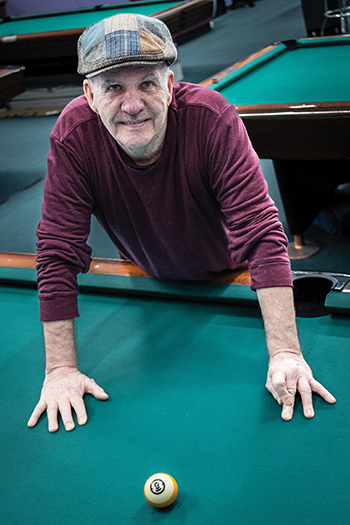 (Photos by Pete Marovich) Despite his years of ghosting the game, McCready still misses the action. He dreams of being in the center of the arena again one last time. He has thoughts, despite his age and declining eyesight, of making a comeback one day in some local bar table tournament and snapping one off for old times' sake. “I wouldn't say I'm retired,” he says. “Let's just say, I'm temporarily on hold. I'm not closing the door. The competitiveness is still there. I miss beating people. I especially miss beating champions. But my days of playing on a 4-by-9, of beating champions, well, that's over. And I won't go to tournaments just to show my face. It's not in my DNA.” McCready reminisces about the take-no-prisoners, after-hours mano-a-mano shootouts of his 1970's heyday. The combat is what he calls it, that fight-to-the-death attitude that is mostly a thing of the past. He loved when things were not so safe; when the bet was high; when there were real hard-nosed rivalries, when the pressure was constant and palpable and could make even the best players dog it; when he was shooting for his road expenses and hotel money and food and rent. He lived for those late-night double-or-nothing battles where one mistake meant blowing your bankroll. “That's when pool was fun,” he says. He was so triggered by the lack of bona fide gamble in a Facebook post by Tony Chohan months ago, he went off in typical McCready fashion. The post included a picture of Tony and Shane Van Boening in a car together, smiling, talking about driving to a one-pocket challenge match to play each other at Rack City Billiards. McCready could not contain himself. He jumped on the thread with a mix of rawness, nostalgia, bad punctuation, and lots of emojis: “Yeah I (know) that it's ok to be friends and everything but it's not the same as if you were muscled up,, no kickbacks, no appearance money,, playing for your life,, trust me I get it,,, it is what it is and love to see 2 great players going at it but for me it just feels a little different,, ha ha,, I want to see somebody's nuts shrivel up,, sweat coming down,, and (their) eyes (laser) focused in the heat of the moment,, and let's not forget about the real pressure,, I hope this doesn't offend anyone,, “Myself I couldn't be 2 or 3 hundred thousand loser to one guy and have to play a charity match with the same guy that beat me and can't even play a set for 50,000,, but being broke I guess you will do anything to pay bills and try to come up,, I get it,,,, I understand it,, make sure you at least go out and get one of those big brown trout,,, good luck,,” It was pure Keith. Pure poetry. Straight, no chaser. Not long after he rises, McCready is feeding Ducky, his rescue Labrador “who he loves like a son,” Jennie says, and who replaced his previous Lab, Mickey, who died of bone cancer at 13 years old in April 2025. “Keith cried like a baby when Mickey died,” Jennie says. Around noontime, wearing his bright red Redskins hoodie, he is walking Ducky along a woodsy, dirt trail leading to the famous Rock Creek Park, where he often sees deer as well as occasionally rabbits, racoons, foxes and snakes. Imagine it, the unthinkable: Keith McCready in the wild. Once a nocturnal creature terrorizing all-night poolrooms in the wee hours of the night, one of the cornerstones of the high-gambling Wild West pool of the colorful '70s, he strangely finds himself here in the afternoon sunlight, connected to nature for the first time in his life, surrounded by trees, living a simple, predictable, clean, and sober life. For decades, McCready teetered on the edge of self-destruction, played within the haze of a heavenly high, a fast-and-loose player ready to implode at any moment. Now he is smack in the most unexpected time of his life — old age, on Medicare, a homebody tending to his garden, yanking weeds and raking leaves, as well as doing such mundane chores around the house like laundry and dishes and taking out the trash. “He ran in the fast lane for many, many years,” Jennie says, “Now he's doing 20.” Not a soul saw this coming - a settled-down Keith in the golden years of his life, reduced to gambling on his phone wearing glasses. “He is happy to have a roof over his head for sure,” Jennie says. “He's never had a stable home life before. Never had medical insurance. He loves going to the doctor now. Unlike me. He finally fixed his rotten teeth. Had them all pulled and wears dentures in public now that look like real teeth. This is the first time in his life he had to learn adult skills. He never had a (government) ID, or a Social Security card, or nice clothes. Now he does. I'm trying to teach him how to cook. He still thinks heating a can of soup is cooking.” Fifty years ago, McCready, famous for playing pool hustler Grady Seasons in the 1986 Scorsese flick “The Color of Money” (uttering one of great lines in cinema history: “It's like a nightmare, isn't it? It just keeps getting worse and worse.”), was a mop-headed, swaggering, boozy, wise-cracking, unpredictable, eccentric, in-your-face teen savant, an utter pool phenom competing with the best of the best and challenging anyone who got in his path. He was fearless. Pure chaos, pure brilliance. Battling demons with a seeming death wish. And making jokes along the way.  Whether in his easy chair with Jennie Ann or on his daily walks with Ducky, McCready is content as he approaches 70. He would flitter around the table non-stop before and after games, talk to the crowd loudly and incessantly, flail his arms to make points. He would shoot with a cigarette in his mouth and occasionally barefoot. He would fidget endlessly in his chair, or when he stood awkwardly cross-footed. He often played with a borrowed cue —and borrowed money. And he would blurt out cryptic things in the middle of games — Keithisms sounded on blast: Man overboard! when somebody scratched. All pockets stand by! when he went for a Hail Mary shot. Hello, dice! when he made a great out. Hold the phone! when his opponent missed. “I was definitely a show,” he says. “I played for the money, but I also played for the crowd.” Almost everything he did was different, odd, but funny and exceedingly entertaining, so riveting you could not take your eyes off him. During matches, McCready chugged bottles of Budweisers like they were sodas, as much as a case by the end of the day. He chain-smoked Marlboros to the tune of three packs a day. It was an open secret that he snorted cocaine, dabbled in smoking crack, popping speed. “I did whatever it would take to level me off. I needed to calm my nerves,” he says. “I never put a needle in my arm. I promise you that. And, to be honest, I had fun drinking and doing drugs sometimes. I wouldn't take anything back - that is, except for the cigarettes. I wish I had never smoked. “But hey, it was the '70s. I wasn't the only one doing drugs back then, believe me.” Then for emphasis, a stern: “Believe me.” “The World's Got The 8,” McCready's infamous T-shirt read - a brazen, cocky, thumb-nosing way to draw instant action, his version of barking without saying a word, a bravado he easily backed up. Back in the late 70s to the mid-80s, for a solid five-year period, he was proclaimed by many the best 9-ball player on a bar box in America, playing at such an ungodly speed, especially unbeatable on a 4X8 bar table with a big cueball, he spotted a list of future hall-of-famers – and as he says “I busted every one of them.” Eventually, once word got around “road players would make a detour from Los Angeles,” he says. “I was a monster on a 4-by-8 with a heavy ball. I had a certain gear that was so devasting (my opponents) didn't want to play anymore, where they were scared to death to miss a ball. I'd run 5, 6, 7, 8 racks. They'd get one dose of that and be gone. I'd play 20 hours and miss two balls. And if I got past the 5th, 6th hour, they were mine. The longer I player, the better I got.” Legend has it that McCready once spotted California's well-known “Little Al” Romero the 7 in 9-ball on a regulation table, seven ahead, then proceeded to run out three sessions in a row, or an incredible 21 straight racks. “Winner breaks, Keith was dangerous,” says BCA Hall of Famer Allen Hopkins. “He could run a lot of racks. He broke the balls well, and when he had to come with the shot, he came with the shot.” He spotted a 22-year-old Kim Davenport the 6-ball and ran right through him. “He did things I had never seen,” says Davenport, who became a BCA Hall of Famer 40 years later. “He really opened my eyes.” McCready would fire at a “white flag,” the late Danny DiLiberto, a One-Pocket Hall of Famer, once observed. He went for shots no one else dared. Manhandled the table. Crushed psyches. Rail first, three-rail kicks, power draws, power follows, ultra-thin cuts, crazy off-angle banks. Eye-popping stuff. “I've seen him make some banks I still can't believe he made,” says Scott “The Freezer” Frost, one of the best bankers in the business. “I wasn't afraid to go for my hole,” Keith says. “I wasn't ducking for my money.” Former player and ref Jay Helfert, who played in the same rooms as Keith for decades, says, “The Mexicans had been the dominant bar table players until Keith came along. He beat all of them and would spot their champions the eight ball. No one wanted to gamble with Keith after a while, and he feared nobody or no bet. There was no such thing as pressure for him. He loved it. The harder the shot, the more he liked it. And he made everything look so easy. Very intimidating.” Pool commentator par excellence Billy Incardona, once an action player known as 9-Ball Billy, remembers seeing Keith play for the first time at The Billiard Palace in Bellflower, when Keith was around 15 years old. The game was Pay Ball aka Pink Ball on a tight-pocket snooker table, a high-stakes 6-ball ring game popular on the West Coast in the 70's and 80's. Keith refers to that game as “Action Jackson!” The other players were the likes of Larry Liscotti, Jimmy Reid, Richie Florence, Ronnie Allen, Cole Dickson, Denny Searcy, and Incardona himself. Pool's equivalent of Murders' Row. “And Keith is this kid winning consistently,” Incardona says. “Talk about a prodigy. Great natural talent, incredible skill, and no fear. How do you beat that? His aggression, his shot-making was off the charts. He never saw a shot that he thought he couldn't make.” Incardona saw Keith a few years later gambling at a tournament in Burlington, Iowa: “Super tight pockets and a deep shelf. If you didn't hit the pocket pure, the ball wouldn't fall. Keith kept hitting the center of the pocket again and again. He beat Wade Crane and Mike Sigel at the top of their game. He beat everybody who wanted to gamble. Six top players stepped up to play him. None of them could beat him.” McCready had such ominous nicknames as Earthquake, Keither with the Ether, the Evil Doctor, and El Diablo among the Mexican players, “The Devil” in Spanish.  Fearless and entertaining, McCready had some tournament success, but looked at the events as opportunities to gamble. With that iconic sidearm stroke, shot righthanded from the hip, akin to straight-pool legend Ralph Greenleaf, McCready craved, hunted, lived for action 24/7. The minute he entered a pool hall, you could feel the earth shift. You sensed something was going to happen. Keith made things happen. He certainly was not there to watch. He played until all hours of the night and for days on end, adding sleep deprivation to everything else. And when he did sleep, it was occasionally under a pool table. The over-under back then on how long McCready would live was around 30 years old, with most people betting the under. But, shock of shocks, here he is nearly 40 years beyond his expiration date. His eyes are shot. He wears glasses for reading and watching TV. He suffers from incurable macular degeneration – the bad wet kind – which requires daily eye drops and regular eye injections and threatens to blind him one day. He battles lung issues, early-stage COPD. He has an enlarged prostate. Nasal issues. He is borderline diabetic. And has a bad back. “His doctor said to him after taking X-rays of his spine, ‘I don't know how you're standing,'” Jennie says. Yet, somewhat miraculously, he is indeed standing after all these years. “His memory is amazing,” Jennie says. “He remembers every shot he made or missed, every dollar he won or lost.” He is looking healthy with a clear sparkle in his eyes, looking good with his clean-cut, military-barber haircut, and even distinguished wearing his Peaky Blinders houndstooth cap over his salt-and-pepper hair. He still has that veiny, bulbous drinker's nose, but it is not nearly as pronounced as it was in his earlier years; he has, in a way, grown into it. One of the last times Keith went to a tournament, Jennie had him looking sharp: He wore a collared shirt, leather shoes, dress pants, hair neatly brushed; a hotel doorman, who knew Keith for years, told Jennie: “I don't know what you did to that guy, but he seems completely different.” Jennie has Keith staying fit. He rides the stationary bike, churns on the elliptical machine, treks his daily 8K steps (mostly walking Ducky three times a day). Takes vitamins daily. He still loves his Italian ices, pizza, spaghetti and meatballs, garlic bread, and cobbler smothered in vanilla ice cream, but he has toned down his cravings quite a bit. “He's a stickler about his health now and is afraid of diabetes,” says Jennie, who has him eating lots of salads and drinking citrus-flavored “anti-oxidant infused” water. “But Keith is one of those guys,” she says, “who can eat anything and not gain an ounce.” For the record, by Keith's sheer will, if not more Jennie's unrelenting watchfulness, McCready has been drug- and alcohol-free, except for cheating with a few beers, for two decades, cigarette-free for 14 years, quitting cold turkey after smoking for nearly 40 years. “I have alcohol in the house,” he says, “but I never touch it.” He takes great pride in the fact that he has so dramatically turned his life around, stayed breathing while most of his contemporaries are long gone. It has been a difficult road, a constant struggle. Lots of mind over matter. Still, internet trolls in pool chat rooms continue to doubt him, make cheap jokes about his sobriety. It infuriates him to no end and provokes him to occasionally confront them online. “It's those negative keyboard warriors,” he says angrily. “They don't know what they're talking about, they don't know me. I shouldn't get so mad, but I do. I want to say more, but Jennie won't let me.” It makes Jennie even madder. She pushes back hard on Keith's behalf. “He's so misunderstood,” she says. “A lot of people seem to enjoy making fun of him. But he's such a good man, with such a good heart.” Jennie points to a match between Keith and the late George “Ginky” SanSouci on the front table at Hard Times in Bellflower, California, many years ago. The bet was eight-ahead for $8000 playing 9-ball. Keith was in dead stroke and ahead five games, when suddenly Ginky got a phone call and instantly broke down in tears; his mom had died. Keith, playing with his own money, let Ginky out of the bet and told him to go home and take care of his family. “I didn't want him to play under those circumstances,” he says. “I mean, money is important. Don't get me wrong. But it's not that important.” Ginky never forgot Keith's kindness that day and the two remained good friends until Ginky died in 2011. “That's who Keith is,” Jennie says. 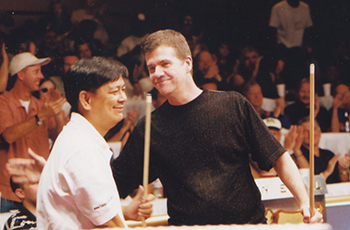 McCready's personality endeared him to competitors like Parica. Jennie types 150 words a minute and does same-day rush jobs transcribing for politicians, journalists, Federal Government entities, and the courts. Her claim to fame was being the court reporter who transcribed Monica Lewinsky's Senate testimony in February 1999. She and Keith met at the Capital City Classic in 2002, in Maryland, outside the Ramada Inn taking smoke breaks. Jennie initiated the conversation, asking Keith if he remembered a road player named Geese aka Mike Gerace, whom she dated for a time and has since passed away. She secretly knew that Geese and Keith were old friends. A conversation ensued. And that was that. “He looked like a mess, but I was enamored right from the start, totally smitten,” she says. She was warned by others in the pool world to stay away from him, that Keith was nothing but a “drifter, a rolling stone,” but she could not stop herself from falling in love in him. “That first kiss,” she says, “I went dizzy.” Jennie is an early riser, wakes up at four in the morning every day to walk Ducky; Keith is still in REM sleep. “We're definitely ships passing in the night,” Jennie says. They connect the gap in their timelines by taking walks together with Ducky every afternoon and early evening. “She loves me,” Keith says. Then with a laugh: “At least she does most of the time.” Jennie gave Keith an ultimatum decades ago: Stop the drugs and alcohol and bad habits, or else. As in goodbye. Keith stopped. “I quit at just the right time,” McCready says, taking a long pause before adding matter-of-factly: “Thanks to Jennie. If not for Jennie, I'd be dead right now. She saved my life.” “Keith would love to be in a poolroom, I know that, it was his whole life,” Jennie says. “But he puts up with me and knows I'm looking out for his own good. I don't want him to be in a poolroom alone anymore. I'm worried that he might go back to his old ways.” McCready was born in Elmhurst, Illinois, but the family, which included two older brothers, Mark and Don, moved to Anaheim, California, when Keith was four years old. He had a turbulent childhood. His parents did not get along, ultimately divorced. His mother, whom he describes as “a hard worker...an upbeat, positive person...fun-loving,” died of breast cancer when he was around 10. Home life was never the same after she died. His father drank too much and did not have the parenting skills to manage three wild sons. Dad was the one who introduced his sons to gambling at a young age. Dad would play cards and pitch coins with the kids for their $20 allowance money – until he won all the money back. The boys eventually gambled pool with each other on a table in a neighbor's garage. By 13, Keith was already a very good player and gambling hours upon hours in the local poolroom, hustling up money - then parlaying the winnings betting at the racetrack with friends. He did not want to be home and he did not want to go to school. He missed over 100 days of school in a row and ended up in juvenile hall. He was always in an out of juvie. Until one day he was suspended for asking his gym teacher to hold $14,000 of track winnings that he was afraid to put in his locker or bring home. “I had money stuffed into four pockets,” Keith says with a laugh. The teacher reported it. Social services were alerted. And Keith was removed from his family and made a ward of the state. When Bob Wallace, the owner of the local poolroom, Bob's Billiards, heard about it, he went to court and petitioned to adopt Keith, so the young boy would not be put in a foster home. 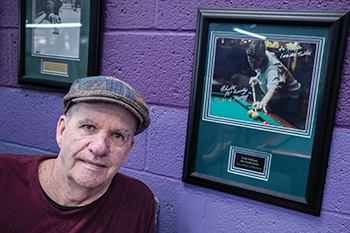 “Earth Quake” is still remembered with reverance at a local poolroom near D.C. By 15, mentored by Cole Dickson and staked by “Hawaiian Brian” Hashomoto, two legendary road hustlers, McCready made his first road trip, complete with fake IDs, traveling to Tucson and Oklahoma City; he made $6,000. Three years later, he was so untouchable that players only dared play him with a huge spot. “I had that label where anybody who came near me got broke,” he says. He was 22 when he won his first big tournament, the 1979 Sacramento 9-Ball Open, hitting road legend Larry Hubbart with a nine-pack in the finals, coming back from down 2-6 to defeat Hubbart 11-6. In 1984, in Clyde Childress Memorial 9-Ball Open, he pulled off the rare feat of beating Earl Strickland twice – 11-2 early in the tournament and then 11-9 in the finals. His last win was the Virginia State 9-Ball Championship in 2005. But while Keith won his share of tournaments and had high finishes, he never won a world championship and his highest finish in the U.S. Open was 3rd place in 2003. Not enough for the BCA Hall of Fame, but easily enough for the One Pocket Hall of Fame's Lifetime of Pool in Action. “I was never very big on tournaments,” he says. “I went to tournaments just to hang around for action, or tournaments that had big Calcuttas. I mean, if I won the first 3, 4 matches, I'd concentrate on winning the tournament. But if things went South, well, I was looking elsewhere.” Sometimes, he would even forfeit matches to gamble at the Craps table, eschewing the top prize of $15K for $50K in dice winnings. Or gambling all night and missing matches. Jay Helfert remembers seeing Keith at tournament lulling around the hotel minutes away from a match. “I said, ’Hey Keith, you've got a match soon.' He smiles at me and says, ’I just won my tournament,' and reaches in his front pocket and pulls out a huge fistful of money, what looked like all hundreds. He laughs, reaches in his other front pocket and pulls out another similar sized wad.” In October, “The Color of Money” celebrates its 40-year anniversary. Keith is still proud of the job he did in that movie (especially ad libbing “You got lucky, you lucky prick”), still honored to have played alongside such movie stars like Paul Newman and Tom Cruise and directed by a filmmaking giant, Martin Scorcese. “Brings back good memories,” he says. The fact that he beat out every pool player with a pulse for the sizeable role of hustler Grady Seasons is something “they can't take away from me,” he says. But in the end, the movie did not really change anything. It was just two weeks and three days of his life. McCready has hardly seen the movie in all the years since. Maybe five times. “I'm over it,” he says bluntly. It made him recognizable in public for a short while, but not a name star outside of the pool world. He never acted in another movie. He never got rich from it. If anything, it caused jealousy among his peers. And knocked his game. “I was recognized in places I would've never been known before,” he says.  McCready freely admits that faithful Jennie Ann saved his life. He does not apologize for the way he has led his life or regret anything other than starting smoking as a teenager. He did what he did. Lived life on his own terms. “Peaks and valleys,” he says. Flush with money one day, busted the next. “I've lived it all. Done it all,” he says. He pauses, then adds with dead seriousness: “If you ain't strong-willed, pool can take you down.” Almost all his best friends, the gods of pool in his era, are gone: Larry Liscotti (at 57 years old in 2004, from lung cancer), Jimmy Reid (at 70 in 2016, from liver cancer), Ronnie Allen (“who was like a father to me,” Keith says, at 74 in 2013, from both diabetes and excessive drinking), Cole Dickson (at 62 in 2013, from liver cancer), Hawaiian Brian (at 75 in 2019, cause unknown). “I think about them all the time,” he says. “All...the...time.” His brother Don passed away as well, in 2006 of multiple sclerosis. He once joked that if he died, he would just come back as a cueball and give everybody bad rolls. McCready could have easily become another pool tragedy, another uber-gifted pool player dying too young from hard drugs and alcoholism. Instead, he is here now, one of pool's true one-of-a-kind characters, a living legend, with a woman a few feet away who absolutely adores him, who watches over him, who always has his back, and rolling on the floor with Ducky like a little kid. “My precious little boy,” he coos, cuddling with Ducky. He is laughing heartily, having the time of his life and, against all odds, still very much alive. |
|
Since 1978, Billiards Digest magazine has been the pool world’s best source for news, tournament coverage, player profiles, bold editorials, and advice on how to play pool. Our instructors include superstars Nick Varner and Jeanette Lee. Every issue features the pool accessories and equipment you love — pool cues, pool tables, instruction aids and more. Columnists Mike Shamos and R.A. Dyer examine legends like Willie Mosconi and Minnesota Fats, and dig deep into the histories of pool games like 8-ball, 9-ball and straight pool.
Copyright © 1997 - 2025 Billiards Digest
All Rights Reserved
Luby Publishing, Inc.
310 Busse Highway PBM #319 | Park Ridge, IL 60068
Phone: 312-341-1110 | Fax: 312-341-1469