
|
|
|
| HomeAbout Billiards DigestContact UsArchiveAll About PoolEquipmentOur AdvertisersLinks |
|
Browse Features
Tips & InstructionAsk Jeanette Lee Blogs/Columns Stroke of Genius 30 Over 30 Untold Stories Pool on TV Event Calendar Power Index |
Current Issue
Breaking News The evolution of the break cue added another club to players' bags, and an entirely new category to the offerings of manufacturers and dealers. By Keith Paradise From the time that she began playing pool, Jasmin Ouschan discovered that she could break the balls really hard. This was during the 1990s, when balls were racked with wooden racks, usually by opponents. This gave each player a similar breaking strategy: hit them hard and hope, while trying to also park the cue ball near the center. The teenaged Austrian had a knack for being able to let loose on that opening shot, a skill that wasn't common at the time, especially in young female players. “I was pretty much one of the only ones that could do that,” said Ouschan, who still has one of the most powerful breaks among female professionals and works with junior females on their breaking technique. “It was a big advantage. So, in my younger years at European Championships, it was definitely a weapon.” Something that was not a weapon in her early days was the break cue that she was using, as the stick used for pool's opening shot was still in its embryonic stages. Prior to the evolution of the break cue, players customarily used a less elaborate playing cue or even a house cue for if playing in a poolroom. The cues were equipped with leather tips similar to those on the playing cues, with the phenolic tip still a few years away from being discovered. In fact, although she can remember almost every playing cue she used during her junior playing days, and even still owns some of them, Ouschan hardly recalls any of her early breaking. 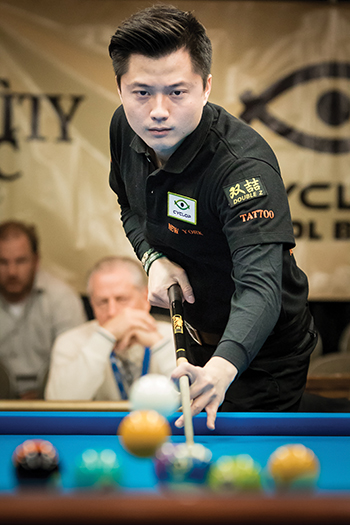 “You just had an extra cue for breaking, but you weren't playing with that one,” she said. “There was nothing special about it. You know, it was not built differently as far as I remember.” That certainly isn't the case these days, as the break cue has evolved into pool's version of a golf driver. What started as a way for players to protect the tip on their playing cues has become a way to smack the rack with a combination of added power and control. It has also become a growing segment for manufacturers and retailers alike. At the beginning of the century, billiards equipment distributor CueStix had three break cues available in its catalog. Currently, the company offers over 120 different makes and models of break cues — some with carbon fiber shafts, some with wood, some that are a combination break cue and jump cue. The cues range anywhere from $100 for an entry-level model to over $1,000. “They're definitely a unique product that is great for retailers because we are able to sell more pool cues,” said Keven Engelke, manager at online retailer Pooldawg.com, which currently lists over 140 break cues on its website. “It's just a whole product line that didn't used to be there that is now something that everybody wants in their bag.” Most cue manufacturers estimate that break cues account for approximately 10-to-15 percent of their company's overall cue sales, while Karim Belhaj, Chief Operating Officer of Predator, said break cues make up closer to 25 percent of company's overall cue sales each year. As break cue technology has resulted in a stick that is more powerful, the cues have become a fashion statement as well. Predator has offered limited edition models of its BK Rush in special colors like orange, gold, green and pink for Breast Cancer Awareness month, with customers many times paying a premium price for this equipment. Engelke said the purple edition Rush, which debuted a couple of months ago, sold out in days. Meanwhile, other companies are beginning to follow suit. Wes Bond of Bull Carbon said the carbon fiber cue maker will be offering its break cues in various colors in the upcoming months. “Break cues have evolved into its own category,” said Andrew Weber of CueStix. “And people have gone absolutely bonkers with the customizing — from the tip, the ferrule underneath it, and the color of the ferrule.” Although the cue has become more fashionable both literally and figuratively recently with amateur players, the stick was created and grew within the professional game nearly 50 years through necessity at a time when the game was in transition. Mike Sigel was down in his stance and lining up his cue for a shot when he noticed that the tip didn't look quite right. It was the late 1970s and Sigel, who would go on to a Billiard Congress of America Hall of Fame career that included two U.S. Open 9-Ball titles, had spent the early part of his career playing straight pool in his hometown of Rochester, New York. As he went out on the road more and sparred in gambling matches, he switched to playing 9-ball and other disciplines. As the decade ended, 9-ball also was becoming a more popular tournament game as the fast pace and loud, powerful break shots allowed for more bite-sized television viewing. Sigel, like all players of this era, used his playing cue to break and would lift up after the shot, holding the butt end of the cue upwards while the shaft of the cue bent on the table like a fishing rod that had just snagged a bass. He noticed that the tip was lopsided and, when he unscrewed the cue and rolled the shaft across the table, it wobbled like a flat tire. This wasn't uncommon at the time. The one-piece leather tips of the day tended to either mushroom or flatten as the result of hard break shots. In other instances, a softer tip would harden and play more firmly. “The goal was to keep the playing tip smooth and soft enough, because when you break really, really hard, you're going to compress the playing tip a lot,” said Ralf Souquet, whose Hall of Fame career started in the 1980s and has included two world championships. Sigel reached out to the cuemaker who had built his cue and asked for another playing cue. When the manufacturer, suspecting that he might be trying to just bilk an added cue out of him, asked what he wanted the additional stick for, he told him he was going to use it strictly for breaking. “First thing he said was he asked me was if that was legal,” said Sigel. “I said I'd never heard any different. Nobody even knew.” After experimenting with a 24-ounce cue, Sigel settled on an 18.5-ounce model that he used for the remainder of his career, then added a larger case made by Jack Justis to carry the two cues around to tournaments. He received a couple of odd looks and comments the first couple of times he used the cues at a tournament, but over time his fellow professionals all eventually switched to using a separate cue for breaking as well. “I doubled everyone's pay,” Sigel laughed. “Because everybody now plays with a break cue.” Around the time that Sigel was experimenting with break cues of varying weights, Bob Meucci, founder of Meucci Cues, was doing a bit of research of his own. He had used high speed cameras in the past to record the locations on his cues where the stick flexed when the cue ball was struck, discovering that the cue flexed in the forearm, joint and in two places in the shaft. Using this information, he developed a cue for breaking that was stiffer behind the joint on the forearm and also had a thicker shaft diameter. Armed with the visual knowledge of his cue's performance and his newly crafted break cues, Meucci wanted to examine which weight would be best for breaking, hypothesizing that an 18-ounce break cue would perform better than a 21-ounce model since it was lighter. To test his theory, he recruited professional David Howard, who was one the hardest breakers in men's pool and, most importantly, under contract with Meucci. When Howard broke with the heavier cue, his cue ball speed was 18 miles an hour and when he broke a rack with the 18-ounce model, Howard's speed allegedly improved to 32 miles an hour. 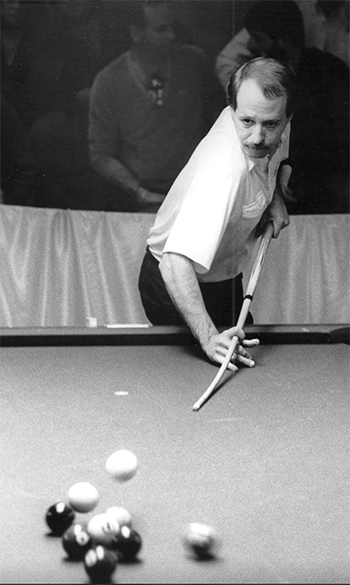 Sigel's cue suffered from his break shot follow through. By the early 1980s, Meucci also had added the break cue to its product line. At one point, 17 professional players were using the cue. Dan Janes of Joss Cues also entered the market with the Zorro, a jointless black cue that could be tweaked to be heavier or lighter. “It was a utility cue to save your playing cue is what it boiled down to,” said son, Stephen Janes, who began working at Joss in 1979 and currently operates the family-owned company. Which is what the cues remained throughout the 1980s and most of the 1990s. As the industry inched towards the 21st century and the creation of a dedicated cue for jumping the cue ball emerged, tip manufacturers experimented with harder tips and ferrules that would cause a spring-like effect. When he wasn't competing, professional player Mike Gulyassy had been working with Bill Schick and Mike Roberts on their line of It's George cues while performing repairs and working on cues of his own. He had been examining a jump cue introduced by John Barton called the Bunjee, which contained a trimmed down leather tip atop of a phenolic ferrule. As he observed one of his employees adding a ferrule on a cue in his shop, Gulyassy walked over and took over the installation. “Watch this,” he said, as he rounded off the ferrule to mimic the shape of the tip, ultimately creating a one-piece ferrule and tip combination. He walked over to a pool table in the facility and tested out the cue's jumping abilities, which it performed with ease. The Sledgehammer jump-break cue was born and became an overnight sensation, with Gulyassy patenting the idea and making $500,000 in sales the first year that the stick was on the market. Multiple players interviewed for the story consider the cue to be a literal game changer, including Ouschan, with the Sledgehammer ushering in the era of phenolic being used as a breaking tip. “Anything that can jump a ball is going to have more power breaking,” said Gulyassy of the material. “I could tell that the break tip didn't put as much spin on the cue ball as did a leather tip if it was hit off center,” said Sammy Jones, who was one of the first players to acquire and adapt to this new technology. “It was more forgiving with the spin and or deflection with the harder tipped cue. I found that it didn't sling the ball as much as an off hit with the leather tip did.” Around the same time, Belhaj, who had recently joined Predator as an intern and was now working for the five-year-old cue manufacturer, met with co-owner Allan McCarty. He asked McCarty what the most important shot in rotation pool was and McCarty said it was the break shot. Then he asked the owner, who was also an avid golfer, what the sexiest club in golf was. “The driver,” he replied. “Then we should make a cue for breaking,” Belhaj replied. The company spent the next 18 months developing the product using the same low-deflection, multiple-sectioned shaft technology that had made Predator's 314 shaft a success. Almost two years later, the company introduced the first BK break cue, with a matte black finish and gold decaling on the forearm. The cue was an immediate success for what was then a small but growing company, selling approximately 1,000 units in its initial run. 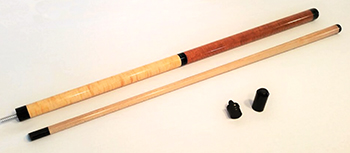 Gulyassy's original Sledgehammer changed the perception of the break cue. “Players would break and feel the difference immediately,” said Belhaj, who is now the president of the company. “It was a very fun process.” If the Sledgehammer changed the perception of break cues, the BK series helped with the cue's overall presentation. Four years later, the second generation BK2 was introduced. With breaking rules at different events beginning to vary, the company was looking to create a cue that would be both powerful and versatile. The second version added weight to the rear, making it stiffer and lighter near the joint. With the owners of the company both being golfers and drawing inspiration from the game, they looked for a manufacturer who could create a rubber wrap that was similar to the grip on a golf club. By this time, cue makers who had not previously developed their own break cues were also beginning to get into the act, such as Jacoby Custom Cues, which debuted the Edge break cue around 2007, which had a wider diameter shaft, laminated shaft and phenolic tip. By the time that the BK3, which included carbon-fiber insert in the shaft to generate more power, debuted about 14 years ago, the product line of most cue makers included break cues and the CueStix catalog Weber managed included approximately 60 break cues from a variety of manufacturers. In 2017, with carbon fiber shafts introduced by Predator a year earlier with the introduction of Revo, Predator introduced the BK Rush. The cue was an immediate success, combining the accuracy and power that carbon fiber offers along with the research and development that came with the previous generations of BK break cue. The industry was quick to catch up, with rival Cuetec debuting its own Breach carbon fiber break cue a few months later and Jacoby, McDermott, Mezz all following suit in recent years with their own version. “I would say more recently, break cues and jump cues have become more of a staple,” said Brandon Jacoby. “It is similar to golf, where you get that new break cue and they can always upgrade that break cue. In the late '90s and early 2000s, it wasn't quite as popular as it is now.” “A lot of people would just break with their playing cue or another teammates cue,” said Bond of KODA, which builds the Bull Carbon line. “But now they see the value in having a secondary break cue.” Part of the popularity has come with the debut of carbon fiber, which gives the cue a bit more power in a sleeker package than the traditional look of a wooden shaft. Using this material also allows the manufacturer to weave the fibers in a denser pattern which can either make the shafts more or less stiff depending on what is needed. Carbon fiber also allows for building a cue shaft that is the same diameter as the player's playing shaft, rather than needing a wider shaft diameter like what was usually needed when using wooden shafts. Lately, manufacturers have been experimenting with new cue tips made out of composite materials in order to give players an equal amount of control along with the necessary power. Bull Carbon uses a composite tip that is harder than phenolic but offers more control, while Cuetec recently debuted the Kintrol break and jump cue tip, which also is made from a glass fiber resin composite. It is also not a coincidence that the emphasis on added control comes at a time that the breaking rules in the professional game have again evolved with the ubiquity of template racks, rack-your-own rules and faster cloth and balls that no longer necessitate a break shot that could knock down a steel door. 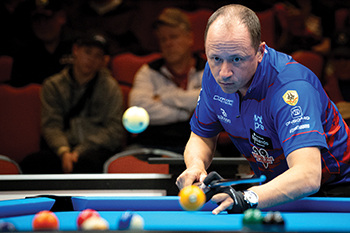 Pros like Shane Van Boening focus on accuracy. “It's always about more power, more control and more accuracy, because the accuracy is a big part of the break nowadays too,” said Brett Garson Global Brand manager for Cuetec. “The way the Matchroom sets up their break boxes and rules, most of the guys will even tell you that it's a very heavy stroke shot more than it is a break shot.” In fact, some professional players have come full circle and are back to breaking with their playing cue — like Jayson Shaw, Shane Van Boening and Darren Appleton. “You want to get the cue ball back into the stack with control,” said Appleton, a former U.S. Open champion who was elected into the Hall of Fame in 2017. “I think with the leather tip, you get more control. That's the only reason why.” With this new technology that has allowed average league players and amateurs to put more speed on the cue ball, Varner reminds that how hard you hit the cue ball isn't nearly as important as how well you make contact. He recalled a breaking lesson given by Johnny Archer, in which he said the three most important parts of the opening shot is where the cue ball strikes the 1 ball, where the tip strikes the cue ball and the cue's speed, in that order. “You know, on the break everybody was hitting them hard,” he said. “But, if you don't hit the 1 ball good and the cue ball good, I don't care if you hit it 100 miles an hour, you might not be able to find the cue ball after you're done.” |
|
Since 1978, Billiards Digest magazine has been the pool world’s best source for news, tournament coverage, player profiles, bold editorials, and advice on how to play pool. Our instructors include superstars Nick Varner and Jeanette Lee. Every issue features the pool accessories and equipment you love — pool cues, pool tables, instruction aids and more. Columnists Mike Shamos and R.A. Dyer examine legends like Willie Mosconi and Minnesota Fats, and dig deep into the histories of pool games like 8-ball, 9-ball and straight pool.
Copyright © 1997 - 2025 Billiards Digest
All Rights Reserved
Luby Publishing, Inc.
310 Busse Highway PBM #319 | Park Ridge, IL 60068
Phone: 312-341-1110 | Fax: 312-341-1469